No. 1 share of imported cosmetics in the U.S. in April
No. 3 is Canada
Online Market "Full Support for Globalization of K-Beauty"
No. 1 share of imported cosmetics in the U.S. in April
No. 3 is Canada
Online Market "Full Support for Globalization of K-Beauty"
A customer is seen picking out cosmetics at a cosmetics store in a U.S. department store [AP]
Korean cosmetics products ranked No. 1 in the U.S. market for imported cosmetics. The U.S., the world's No. 1 beauty market, is seeing an unusual trend in beating traditional
powerhouse France. The world's largest e-commerce companies are also sending a lot of love calls for K-beauty.
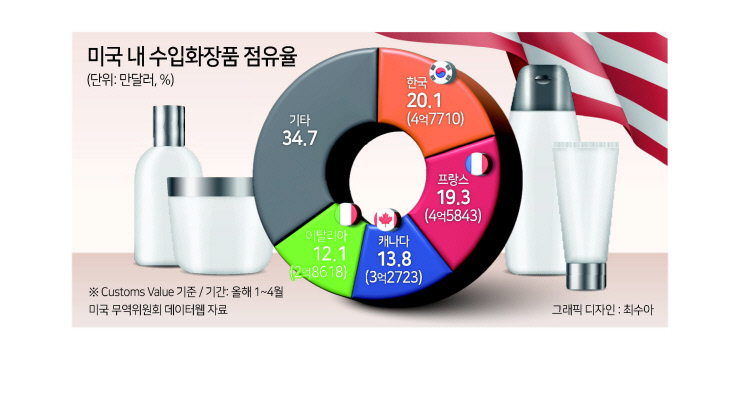
According to the U.S. Trade Commission's DataWeb on Monday, Korea ranked first (20.1 percent, 477.1 million dollars) in the cumulative share of imported cosmetics in the
U.S. from January to April this year. France ranked second with 459.43 million dollars, or 19.3 percent, in the same period. Canada ranked third with 327.23 million dollars in
exports to the U.S.
It is significant that Korea beat France, the world's No. 1 cosmetics exporter, in the U.S. Although France is still ahead in terms of annual terms, there is a possibility that
Korea's cosmetics market will turn around. In terms of monthly imports by USITC this year, Korea ranked first in terms of monthly imports in January and April, respectively.
From February to March, France remained atop.
Last year, the U.S. ranked No. 1 in terms of U.S. cosmetics imports (17.3 percent), No. 2 in Korea (16.5 percent), and No. 3 in Canada (15.5 percent). Korean cosmetics are
now one of the "three major cosmetics" in the U.S. K-beauty became an "icon of reversal," beating France, which has ranked first in the Japanese market for nearly 30 years in 2022.
E-commerce companies said in the "Project K-Beauty Go Big," which plans to support the global expansion of K-beauty brands, "The number of sellers with annual sales of
more than $100,000 (about 130 million won) doubled as of last year," and stressed, "We will fully support the globalization of K-beauty, which has surged in demand." Stylexx
held a "K-beauty conference" at the Intercontinental Seoul COEX Hotel in Samseong-dong, Seoul on the 27th and held a briefing session for K-beauty sellers.
Korean beauty companies are also realizing their popularity. According to AmorePacific, the cumulative sales of the Aestra brand increased 347 percent year-on-year as of mid-
June. The Illiyoon brand also showed explosive growth as its sales increased 570 percent year-on-year as of May this year. AmorePacific boosted its sales growth by promoting
executives such as Laneige and Hera to vice president.
Cosmetics export strategy, which was previously focused on China, seems to be shifting to the U.S. as well. Exporting cosmetics to the U.S. has also become a "new normal" in
the beauty industry. Indie brands, which are leading the export of cosmetics, are also showing interest and support.
"K-beauty has grown so rapidly that Korean products accounted for the top six items of Amazon's 12 beauty this year," said Kim Il-ho, director of global growth at the Small and
Medium Venture Business Corporation. "We are providing various support measures such as export logistics discounts at a time when excellent products are recognized by
overseas consumers and solidifying their position in the cross-border cross-border (CBT) market."
![미국 백화점 화장품 매장에서 고객이 화장품을 고르고 있는 모습 [AP]](https://wimg.heraldcorp.com/content/default/2024/06/28/20240628050298_0.jpg)